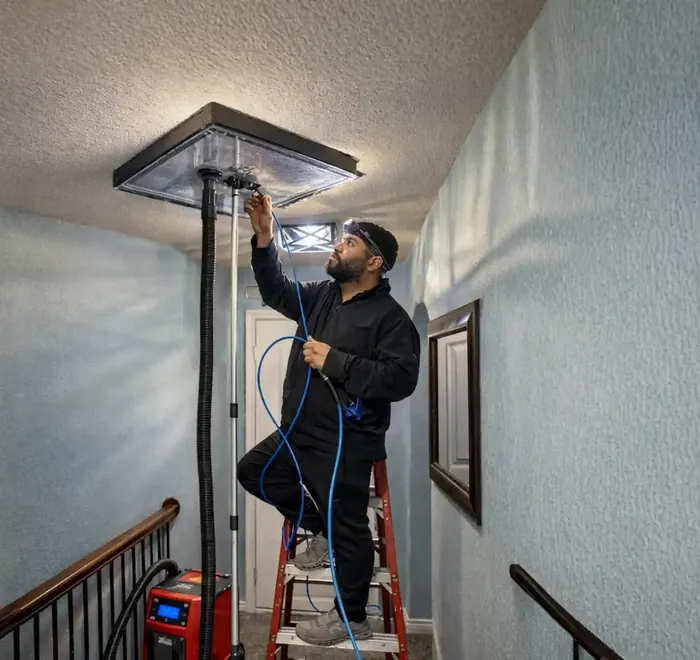
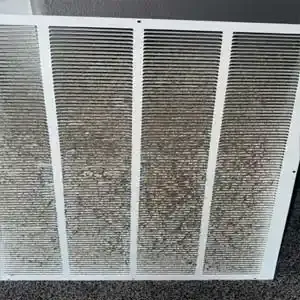
What vent cleaning actually covers
Vents are the only part of the duct system you can see, so they get blamed for a lot. There are three kinds in most Dallas homes:
- Supply registers. The ones that blow air, with adjustable louvers. Ceiling registers in most slab homes, floor registers in some older pier-and-beam houses.
- Return grilles. Larger, no louvers, pulling air back to the system. Often in a hallway ceiling, a wall near the floor, or the closet door of the air handler.
- Return filter grilles. A return grille with a filter mounted right behind it, common in Dallas homes with attic units. These are the ones that get forgotten.
Vent cleaning means taking each one off, washing it, cleaning the register boot behind it (the sheet-metal transition where the duct meets the ceiling), and resetting it. It's the visible part of the job, and it's the part you'll notice when you walk into a room.
Vent-only cleaning vs full duct cleaning
Here's where we're honest about it. Vent-only cleaning makes sense in a few situations, and in a lot of others it's money spent on the wrong part of the system.
| Situation | Is vent-only cleaning enough? | Why |
|---|---|---|
| Covers look dusty, nothing blows out when the AC starts | Yes | The dust is on the face of the grille, not in the run |
| Moving in and the old owner painted over the registers | Yes, plus new registers if they're stuck | The issue is the cover, not the duct |
| Dust puffs out when the system kicks on | No | Debris is loose inside the supply side |
| Return grille is matted with pet hair | No | Hair gets past the grille into the return plenum |
| Construction or remodel dust in the house | No | Drywall dust travels past the boots |
| One vent smells musty | No | The smell is coming from inside the duct or the AC side |
Since our $99 full residential cleaning already includes every supply and return vent on the system, the vent-only question usually answers itself. You'd pay for vents, then pay again for ducts. One visit covers both.
Dust streaks on the ceiling around registers
This is one of the most common calls we get. Gray or black shadows fan out across the ceiling around a supply register, sometimes in a ring and sometimes along one edge.
Three usual causes:
- Fine particles in the air that hit the ceiling and stick. Candles, a wood fireplace, and nearby construction all add to it.
- Dust inside the supply run being pushed out with every cycle.
- A gap between the register boot and the drywall. The vent pulls air from the attic or wall cavity through that gap, and that air is dirty. This is common in houses where the boots were never sealed to the ceiling.
Cleaning takes care of the second. A gap at the boot needs sealing with mastic or foil tape, which we'll point out when we see it. The first is about what goes on in the house. Repaint the ceiling after the source is fixed, not before.
Returns deserve more attention than supplies
If you only look at one vent, look at the main return. It's the intake for every bit of air the system moves, so it catches the most pet hair, lint and dust. A clogged return grille or a filter that's been in too long also chokes airflow, and that shows up as longer run times in July.
On a job in Celina, the crew started with the return side for exactly this reason. Loosen it, capture it at the vacuum, then move to the supplies. If you only clean supply vents and leave a dirty return, you're feeding the dirt right back into the system.
Floor registers and high wall vents
Two spots trip people up. Floor registers, common in older pier-and-beam homes in Oak Cliff and East Dallas, catch everything: crumbs, pet hair, the occasional earring. The boot under a floor register is a catch basin, and it fills up. We vacuum those out by hand before the run gets cleaned.
High wall vents in two-story living rooms are the opposite problem. Nobody can reach them, so nobody cleans them, and they collect years of dust on the louvers. Cleaning them properly takes a tall ladder, a drop cloth over the couch, and a vacuum hose long enough to reach.
How we clean vents
- Remove each register and grille and note which room it came from.
- Wash covers with eco-friendly cleaner, rinse and dry them fully so they don't rust or drip.
- Vacuum and brush the register boot while the system is under negative pressure.
- Check the boot seal to the ceiling or wall for gaps.
- Reset each cover, level it, and take the after photo.
For the rest of the house, this all runs as part of the full Dallas air duct cleaning process.
What you can do between cleanings
- Vacuum the vent covers with a brush attachment whenever you dust that room.
- Change the filter on time and make sure it sits tight in its slot.
- Don't close supply registers in unused rooms. It raises pressure in the system and can push dust out at leaky joints.
- If you have magnetic vent covers or filter material taped over registers, take them off. They restrict airflow and trap moisture.
When the problem isn't the vents
If dust keeps showing up after the vents are clean, look upstream. The guide on why dust comes out of the vents covers the usual suspects. If one vent smells musty or there are dark spots on a register, the cause is often moisture from the AC, which we cover on our AC duct cleaning page. For a stubborn smell after cleaning, look at duct sanitizing. And for a look inside before you decide anything, a $69 video inspection shows you what's past the boot.