Why dryer vents clog in Dallas homes
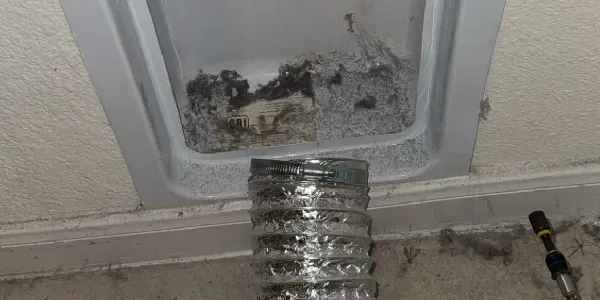
Every load sends warm, wet air and a fine stream of lint down a 4-inch duct. The lint screen catches most of it. Not all of it. The rest sticks to the inside of the duct, especially at elbows and anywhere the duct sags.
A few things make it worse here:
- Long runs to the roof. Plenty of two-story homes in North Dallas and Far North Dallas put the laundry room in the middle of the first floor. The vent climbs up through the wall and attic to a roof termination. Lint loses speed going uphill and settles at the bottom elbow.
- Crushed transition hoses. The flexible hose between the dryer and the wall gets shoved back every time the dryer moves. Foil hose crushes flat. Old white vinyl hose is still around in rentals, and it shouldn't be.
- Wall caps and birds. Sparrows and starlings love a warm dryer vent in spring. A nest in the wall cap can shut it almost completely.
- Screened caps. Some caps have a mesh screen to keep birds out. Lint packs into the screen fast. The residential code doesn't allow screens on dryer terminations for that reason.
The residential code limits a 4-inch dryer duct to 35 feet of developed length, and each 90-degree elbow counts as 5 feet. A lot of Dallas roof runs push right up against that, which is why they clog sooner than a short wall vent.
Why it matters
The US Fire Administration estimated about 2,900 clothes dryer fires in residential buildings each year, causing around 5 deaths, 100 injuries and $35 million in property loss. Failure to clean was the leading factor contributing to ignition, at 34 percent. The same USFA report on dryer fires found they peak in fall and winter, with January the worst month.
There's also the electric bill. A dryer pushing against a blocked vent runs longer for every load.
Signs your dryer vent needs cleaning
| What you notice | Likely cause |
|---|---|
| Towels take two cycles to dry | Lint buildup restricting airflow |
| Top of the dryer or laundry room gets hot | Heat can't escape through the vent |
| Burning or musty smell when the dryer runs | Lint near the heat source, or damp lint in the duct |
| Little or no air at the outside cap while the dryer runs | Blockage in the run or at the cap |
| Lint around the dryer door or on the floor behind it | Disconnected or torn transition hose |
| Flap on the wall cap stuck open or shut | Lint packed in the cap, or a nest |
| Newer dryer shows a vent or airflow warning | The dryer's own sensor detecting restriction |
What's included in our dryer vent cleaning
| Part | What we do |
|---|---|
| Lint trap housing | Vacuum the cavity under the lint screen, where lint collects past the screen |
| Transition hose | Clean it, or recommend replacement if it's crushed, torn or vinyl |
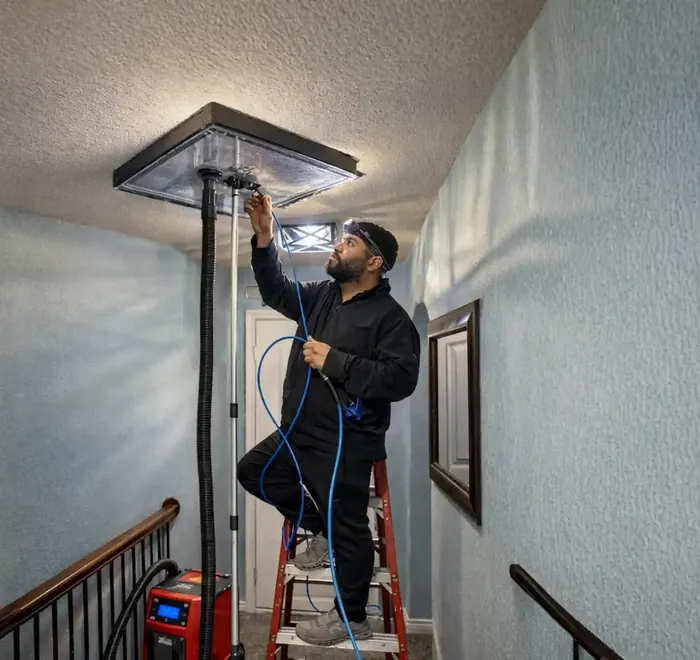
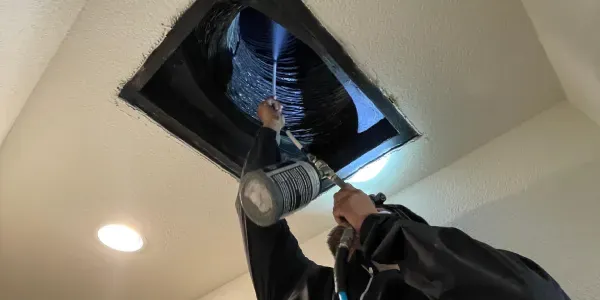
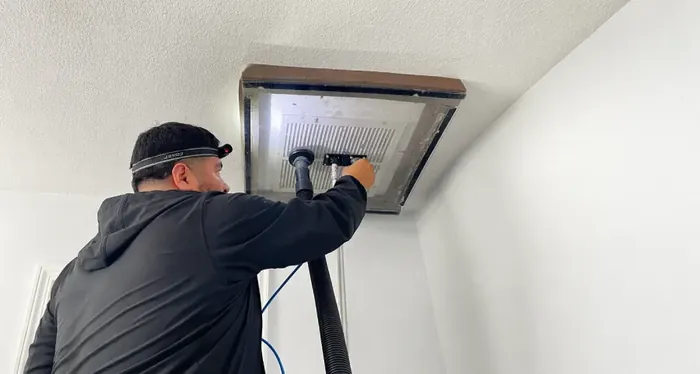
| Duct run in the wall or attic | Rotary brush agitation and compressed air through the full run, lint collected with a HEPA vacuum |
| Exterior cap, roof or wall | Clear lint and nest material, check that the flap opens and closes |
| Airflow check | Run the dryer and check airflow at the cap before and after |
| Photos | Before and after photos of the hose, run and cap |
If the run is disconnected inside the wall, the cap is broken, or the run needs rerouting, we'll show you and quote it before touching it. Gas dryers: we move the dryer carefully, but we don't disconnect or work on gas lines.
How we clean a roof dryer vent
- Pull the dryer out, check the hose, and look at how the run leaves the laundry room.
- Disconnect the transition hose and run the rotary brush up the duct from the inside.
- Push air through the run so loosened lint moves toward the exit while we vacuum.
- Go up on the roof if it's safe to walk, clear the roof cap, and clean the top section from above.
- Reconnect with a proper hose, run the dryer, and confirm air is moving at the cap.
On steep or wet roofs we may clean from the inside only and tell you what we couldn't reach. No sense putting someone on a slick two-story pitch to save a callback.
How often to clean a dryer vent
| Situation | How often |
|---|---|
| Family of four or more, laundry most days | Every year, sometimes sooner |
| One or two people, short wall vent | Every 1 to 2 years |
| Roof termination or long attic run | Every year |
| Pets that shed | Every year |
| Rental between tenants | At each turnover |
| Slow drying, hot laundry room, or a nest at the cap | Now |
What dryer vent cleaning costs
Straight answer: dryer vent cleaning is not part of our $99 whole-home air duct cleaning offer. That offer covers the supply and return vents of your heating and cooling system. The dryer vent is a separate duct with its own access and its own cap, so it's quoted separately and upfront, after we see where the vent ends and how long the run is. If we're already at your house for air duct cleaning, we can usually do the dryer vent the same visit.
For how duct cleaning prices are put together around Dallas, see our cost guide.
DIY vs calling someone
Some of this you should do yourself. Clean the lint screen every load. Once in a while, pull the dryer out and check that the hose isn't crushed or kinked. If you have a short, straight run out a first-floor wall, a brush kit from the hardware store can handle light buildup.
Where DIY goes wrong: pushing a clog further up a long run, snapping a brush rod inside the wall, pulling apart a joint you can't see, or walking a roof you shouldn't. If the run goes to the roof or is longer than about 15 feet with elbows, have it done by someone with the right tools.
Related work while we're there
Roof access is the expensive part of a lot of these jobs, so it makes sense to bundle. If you have a fireplace, a chimney sweep can happen on the same trip. If your registers and return grilles are caked in dust, vent and register cleaning is a quick add.