
Sanitizing comes after cleaning, every time
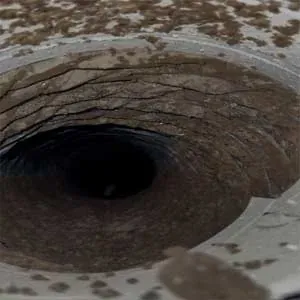
Spraying a sanitizer into dirty ducts is like mopping a muddy floor without sweeping first. The product lands on dust, debris and pet hair, and that's where it stays.
The EPA's position, from its guide on whether to have your air ducts cleaned, is straightforward:
- Biocides and sanitizers should only be applied after the system is properly cleaned.
- They should only go on uninsulated surfaces.
- The product's label has to cover use inside HVAC ducts. Using it any other way is against the law.
- No products are currently registered by the EPA as biocides for fiberglass duct board or fiberglass-lined ducts.
That last one matters in Dallas. Most attic systems here run on R-6 or R-8 flex duct, and plenty of older homes have duct board plenums. Before any product goes in, we check that its label actually covers the surface we're treating. Plenty of labels don't.
Find the smell before you treat it
Most odor calls aren't really about sanitizer. They're about finding what's making the smell.
| Odor | Common source in Dallas homes | What actually fixes it |
|---|---|---|
| Stale cigarette or cigar smoke | Residue on duct walls, registers, coil and filter in a house bought from a smoker | Full duct cleaning, coil cleaning, new filter, then targeted treatment; walls and ceilings need work too |
| Pet odor | Hair and dander packed in returns; urine near floor registers in older pier-and-beam homes | Clean returns and grilles, clean or replace affected registers and boots |
| Sweet, rotten smell from one or two vents | A mouse or rat died in a duct or near a return in the attic | Remove remains, clean that run, treat it, and have the entry point sealed |
| Musty "dirty sock" smell when the AC kicks on | Wet evaporator coil, slimy drain pan, damp insulation | Coil and drain pan cleaning, drain line clearing |
| Sewer smell | Dry trap on the condensate drain, or a plumbing vent problem | A plumber or HVAC tech, not duct work |
| Burning dust at the first heat cycle | Dust on heat strips or the heat exchanger | Usually burns off; if it lingers, an HVAC tech |
| Paint or new-material smell after a remodel | Construction dust and fumes pulled into the return | Duct cleaning and fresh air; time does the rest |
If the source is outside the ducts, we'll tell you and won't sell you a treatment.
Fogging vs targeted application
Fogging pushes a fine mist through the system, usually with the blower running. It's quick. It also puts product on every register face and into every room, and coverage inside the ducts is uneven. The spot that needs it most, like the bottom of the return plenum or the run where a rat died, may get the least.
Targeted application goes directly onto the cleaned section with the problem, using the method the label calls for. It takes longer, but the product goes where the issue is.
We lean toward targeted application. If a label specifically calls for fogging, we follow the label.
Ozone is a different thing. The EPA describes it as a lung irritant, and we don't recommend running ozone through the ducts of an occupied home.
Note: In Texas, treating ducts, plenums or other parts of a heating and cooling system with disinfectants, anti-fungal products or anything designed to reduce mold, bacteria or other organisms is defined as "biomedical remediation" under TDLR's air conditioning rules (16 TAC §75.10), and it requires the right TDLR license. Your written quote names the product, its EPA registration, and who on the job is licensed to apply it. If a treatment needs a license we don't hold for that job, we tell you before we quote, clean the ducts, and point you to someone who does.
What a sanitizing visit includes
| Step | What happens |
|---|---|
| 1. Inspect | Camera inspection of supply and return runs, check of the coil and drain pan, sniff test at each register |
| 2. Find the source | Locate the run, plenum or component where the smell starts |
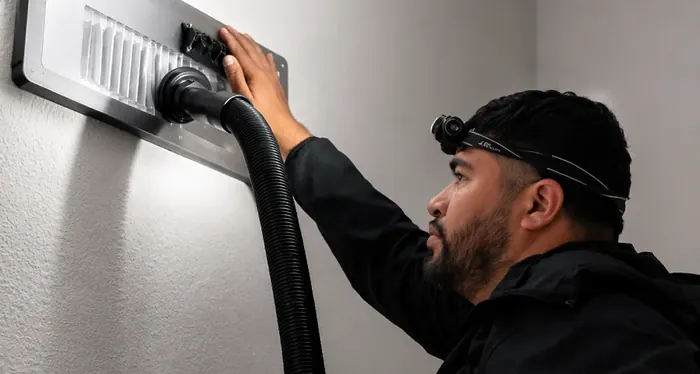
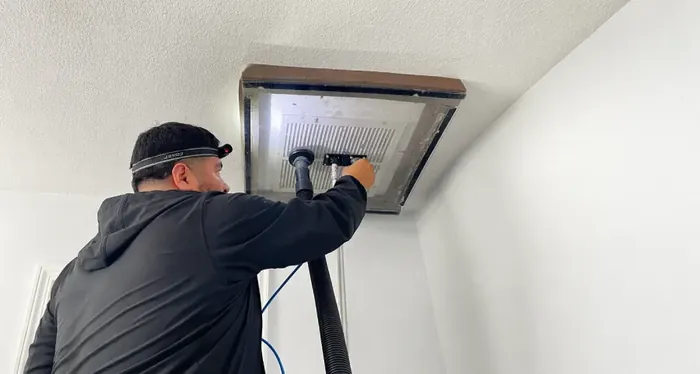
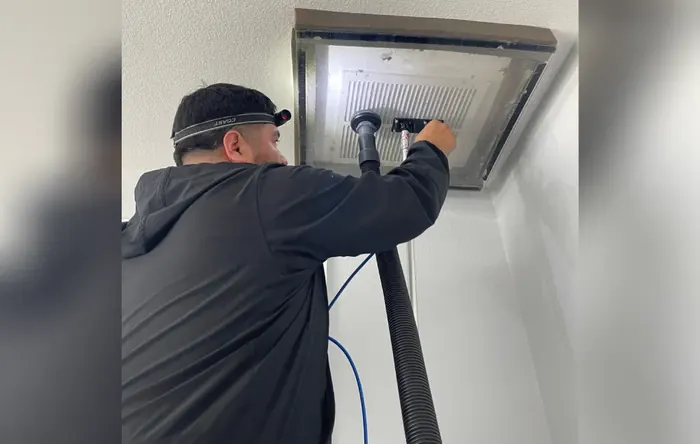
| 3. Clean | Negative-pressure vacuum with rotary brushes and air whips, every supply and return |
| 4. Deal with the source | Remove remains or debris, clean grilles, replace the filter |
| 5. Review the product | You see the safety data sheet and label, and agree before anything goes in |
| 6. Apply | Product applied to cleaned, label-approved surfaces only, by the label's method |
| 7. Air out | Reentry time per the label; kids and pets out until then |
| 8. Document | Before and after photos of the treated sections |
What sanitizing won't do
It won't dry a wet coil or fix a clogged drain line. It won't pull smoke out of drywall or pet odor out of carpet. It doesn't make dirty ducts clean. And it isn't a health treatment: the EPA notes that duct cleaning has never been shown to actually prevent health problems, and a sanitizer doesn't change that.
If the source comes back (another rodent, a drain that clogs again, someone smoking indoors), the smell comes back too.
What it costs
Sanitizing is not included in our $99 whole-home duct cleaning offer. It's an add-on, quoted upfront in writing after we've inspected the system and found the source. Most of the time the cleaning does the heavy lifting and the treatment is limited to one or two sections.
Move-ins, rentals and smoker houses
Odor problems often show up right before a move-in. New owners walk in, smell smoke or pets, and want the system dealt with before the furniture arrives. That's a good time to do it: empty rooms, no one living there, easy access. One of the jobs on our projects page is a vacant home in Hurst cleaned before move-in.
Property managers turning over Dallas rentals see the same thing. A cleaning between tenants, plus treatment only where something was actually wrong, is usually enough.
Related services
Start with residential duct cleaning, since sanitizing always follows it. If you suspect growth rather than odor, read our page on mold in air ducts first. For a look at each step of the cleaning, see how we clean air ducts. And if you're on the fence about the whole thing, is air duct cleaning worth it gives an honest answer.